
Goyard: From Maison Martin (1792) to “Quiet Luxury” Without Mass Marketing
Goyard is often described as elusive, but the story is concrete: it begins in Paris in 1792 as Maison Martin, a workshop known for box-making, trunk-making and the practical craft of packing valuables for travel. From that trade grew a house that still treats luggage as a technical object, not a seasonal fashion item, and that still relies on controlled distribution instead of mass campaigns. Even in 2026, the brand’s modern visibility is mostly a side effect of its history, its workshops, and the way it insists on selling on its own terms.
Maison Martin to Maison Goyard: the lineage is older than the name
The earliest point in the timeline is Maison Martin, founded in 1792 by Pierre-François Martin, who built a reputation for making boxes, trunks and for packing—a service that mattered when travel meant long journeys with fragile possessions. That origin is not a marketing legend; it sits on the brand’s own historical record and explains why the house’s vocabulary still revolves around trunks, travel and protection rather than trend cycles.
In the 19th century, the business passed through hands and names before becoming “Goyard” in the sense most people recognise today. The widely cited “founded in 1853” date refers to the establishment of the Goyard house under that name in Paris, while the craft lineage continues back to 1792. For anyone trying to make sense of the brand, the cleanest way to read it is as a trade that predates the label.
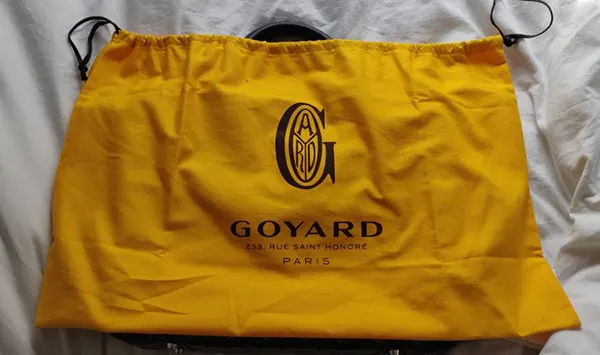
One address anchors the story: rue Saint-Honoré in Paris. The house’s historic boutique is associated with 233 rue Saint-Honoré, a location that became fixed after Paris street renumbering in the mid-19th century. In practical terms, that continuity matters because it is part of how Goyard signals permanence: the shop is not a “concept” that moves with footfall—it is a long-running workshop-facing retail point.
What the timeline tells you about the house’s priorities
If you track the timeline, you see a company shaped by travel technology rather than runway logic. The early focus was on protecting belongings and moving them safely, which is why Goyard’s product ecosystem still makes sense around trunks, travel bags, and hard-wearing finishes. The brand’s modern leather goods sit on top of that base, rather than replacing it.
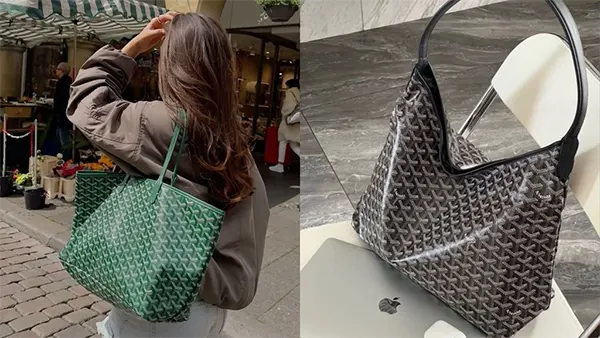
The family era is also important, not because of sentimentality, but because it explains the house’s habit of iteration: refining patterns, materials, and workshop routines over decades. Goyardine, the emblematic chevron canvas associated with the house, is described by Goyard as a hard-wearing, flexible and waterproof technical leap—and the brand still keeps the precise manufacturing process confidential. That combination (performance + secrecy) is a recurring theme in the house’s identity.
A major modern inflection point is 1998, when Jean-Michel Signoles took over the maison and accelerated international expansion while keeping the controlled, boutique-led model. It is one of the clearest examples of continuity through change: ownership shifts, but the house retains the logic of scarcity, workshop output, and direct control over how and where pieces are sold.
Craft as a business model: materials, time, and repairability
For Goyard, “craftsmanship” is not a vague compliment—it is an operational constraint. The house states that its trunks are handcrafted in its workshops in Carcassonne, in southern France, and that a trunk can require several weeks of work. That matters because it sets the ceiling on supply in a way advertising budgets never could.
Goyardine is central to how the house balances weight, durability and recognisability. Goyard describes it as an emblematic canvas that is hard-wearing, flexible and waterproof, while also being produced through a process kept confidential. For a buyer, the practical takeaway is simple: the material is meant to be used, not preserved like costume jewellery.
Another under-discussed piece of the craft story is long-term service. Trunks and travel goods exist in a world of wear, knocks and repairs; a house built on travel historically has to think in decades. When a brand’s reputation is tied to objects that move through airports, trains and car boots, durability becomes part of its credibility, and the product’s “value” becomes easier to understand without relying on hype.
Personalisation: not a trend, a continuation of travel tradition
Goyard is strongly associated with personalisation—stripes, initials, and hand-applied details that make pieces identifiable. In travel history, marking luggage was a practical necessity; it prevented mix-ups and made ownership obvious. Seen in that light, Goyard’s personalisation reads less like a modern add-on and more like an inherited function.
Personalisation also supports the house’s quiet status logic. A monogrammed piece is specific to one person and one story; it does not need mass recognition to feel meaningful. It is also difficult to replicate convincingly at scale, which reinforces the brand’s emphasis on boutique interaction and hand-finishing.
In 2026, that approach aligns neatly with the broader taste for low-volume signals—objects that look understated from a distance but reveal detail up close. Goyard did not invent that mood, but it benefits from it because its product language has long been based on discretion, durability, and private cues rather than public spectacle.
“Secret luxury” without mass marketing: how the house stays visible by staying controlled
Goyard’s modern reputation is inseparable from its refusal to behave like a typical contemporary luxury brand. A key example is digital commerce: the maison states plainly that it does not engage in e-commerce, though distance order services may be available depending on proximity to a comptoir. This policy is more than nostalgia—it forces demand into a limited set of touchpoints the brand can manage.
That touchpoint strategy is reinforced by the boutique network. Goyard maintains a “find a boutique” directory, and the list of locations functions as a controlled map of access. If a city does not have a boutique, availability is structurally limited, which keeps the house from becoming over-exposed through broad wholesale distribution.
When people call this “quiet luxury”, they are usually reacting to the same mechanics: low advertising, selective retail, and supply constrained by workshop output. Whether you like the term or not, the underlying point is measurable. The house stays desirable partly because it is harder to buy than brands that optimise for frictionless online sales.
What this looks like in practice for buyers in 2026
First, availability is not just about price—it is about inventory and timing. A controlled boutique model means popular colours and shapes can be inconsistent, and waiting is part of the experience. That scarcity is not a marketing stunt so much as a predictable result of workshop capacity and selective distribution.
Second, verification matters. Because the brand is widely copied, buyers who want certainty typically prioritise authorised boutiques and documented sourcing. The maison’s choice to keep sales close to its own counters naturally supports authenticity, even if it is inconvenient compared with one-click checkout.
Third, the brand’s silence is part of the product. If you expect constant new releases, loud collaborations, and relentless campaigns, Goyard can feel opaque. If you value continuity—materials that exist to be used, personalisation that feels functional, and a house that treats travel goods as engineering—then the logic becomes easy to follow.