
KENZO: From a Japanese View of Paris to Global Pop Romanticism
KENZO is one of the few fashion houses whose identity was shaped not by geography, but by dialogue between cultures. Founded by Japanese designer Kenzo Takada in Paris, the brand became a visual language that united East and West without imitation or folklore. By 2025, KENZO remains a reference point for cultural hybridity, colour confidence, and the concept known today as “smart ethnics”.
The Origins of KENZO and the Vision of Kenzo Takada
Kenzo Takada arrived in Paris in the mid-1960s with limited resources but a strong visual intuition. Born in Himeji, Japan, he was educated at Bunka Fashion College in Tokyo, where he absorbed both traditional Japanese aesthetics and European fashion theory. His move to France coincided with a period when Parisian fashion was still dominated by rigid couture norms.
In 1970, Takada opened his first boutique, Jungle Jap, in the Galerie Vivienne. The space itself reflected his philosophy: informal, colourful, and open to experimentation. Instead of structured tailoring, he offered loose silhouettes inspired by kimono construction, peasant garments, and travel wardrobes.
From the beginning, KENZO rejected minimalism and restraint. Takada introduced bold floral prints, unexpected colour clashes, and joyful layering. This approach stood in contrast to prevailing Parisian elegance and quickly attracted attention from buyers seeking originality rather than conformity.
Japanese Sensibility within a Parisian Framework
Kenzo Takada did not reproduce traditional Japanese clothing in a literal way. Instead, he translated its principles: freedom of movement, respect for fabric, and harmony between garment and body. This approach allowed his designs to feel natural rather than theatrical.
Paris provided the technical foundation and global visibility that Japan alone could not offer at the time. French ateliers refined Takada’s ideas, while the city’s cultural diversity encouraged experimentation. The result was a hybrid style that belonged fully to neither culture yet resonated with both.
This balance between origin and adaptation became the core of KENZO’s identity. It also established Takada as one of the first designers to successfully position cultural fusion as a modern design strategy rather than an exotic reference.
Prints, Cultural Dialogue, and the Rise of Smart Ethnics
One of KENZO’s defining features has always been its approach to prints. Instead of using motifs as decoration, the brand treated them as narrative elements. Flowers, animals, stripes, and graphic symbols were combined freely, creating visual tension without chaos.
Takada drew inspiration from global travel, folk art, and street culture. African patterns, South American colours, and European florals coexisted within a single collection. This approach challenged the idea that cultural references must remain isolated or historically accurate.
By the late 1970s and 1980s, KENZO had effectively defined what would later be described as “smart ethnics”: fashion that borrows from cultural sources thoughtfully, avoiding caricature while preserving identity.
Redefining Cultural Influence in Fashion
Smart ethnics at KENZO were not about nostalgia or costume. The garments were designed for modern urban life, with practical cuts and wearable fabrics. Cultural elements served as inspiration, not replication.
This philosophy influenced a new generation of designers who sought alternatives to Eurocentric fashion narratives. KENZO demonstrated that cultural exchange could enrich design without hierarchy.
By 2025, this approach remains relevant as the fashion industry continues to address questions of cultural respect and representation. KENZO’s early work offers a blueprint for responsible cross-cultural creativity.
Brand Evolution, Creative Directors, and Global Impact
After Kenzo Takada stepped away from the brand in 1999, KENZO entered a new phase under the ownership of LVMH. Subsequent creative directors brought different interpretations while maintaining the brand’s expressive DNA.
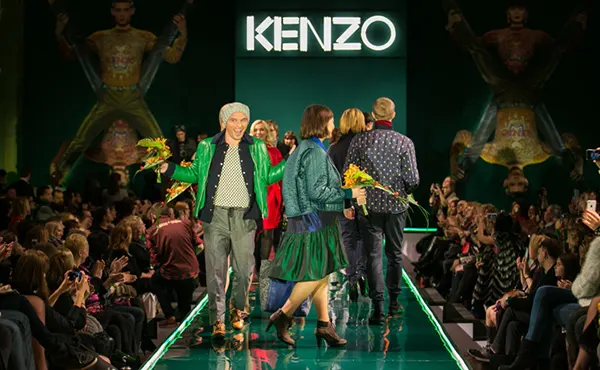
The 2010s marked a renewed global visibility, particularly under Humberto Leon and Carol Lim. Their tenure introduced a youthful energy, streetwear influences, and collaborations that connected KENZO with contemporary pop culture.
Later creative leadership continued to refine the balance between heritage and innovation. While silhouettes and themes evolved, colour, print, and optimism remained constant identifiers.
KENZO’s Place in Contemporary Fashion Culture
In 2025, KENZO occupies a unique position between luxury fashion and cultural expression. It is neither archival nor trend-driven, instead operating as a living system of references and ideas.
The brand’s influence can be seen in the widespread acceptance of oversized silhouettes, print mixing, and cross-cultural aesthetics across global fashion markets.
KENZO’s long-term significance lies in its consistency. From Takada’s early Paris collections to its modern interpretations, the brand continues to prove that diversity and creativity can coexist without dilution.