
Thom Browne: American Neoclassicism and the Phenomenon of the Cropped Suit
Thom Browne has reshaped modern menswear with a vision that blends discipline, tradition, and artistic provocation. His interpretation of American neoclassicism, supported by precise tailoring and an instantly recognisable silhouette, continues to influence the global fashion landscape in 2025. The cropped suit, the reimagined uniform, and highly conceptual runway shows have become essential elements of his creative identity, allowing Browne to establish a distinctive language that bridges craftsmanship and performance.
The Foundations of American Neoclassicism in Browne’s Aesthetic
Thom Browne’s work is rooted in a reinterpretation of classic American tailoring, which he refines through strict proportions and architectural precision. Instead of relying on nostalgic replicas, he builds a modern structure around traditional elements, reinforcing his belief that strong design evolves from discipline and clarity. By integrating clean lines, controlled symmetry, and an emphasis on proportion, Browne redefines what neoclassicism means within contemporary fashion.
His approach draws inspiration from mid-century American corporate attire, yet he intentionally disrupts its rigidity with a sculptural perspective. Jackets with elevated hemlines, narrow trousers, and elongating silhouettes form a visual rhythm that mirrors the measured elegance found in classical design. The balance between historical structure and modern reinterpretation positions Browne within an ongoing conversation about how menswear traditions can evolve without losing their form.
By 2025, Browne’s aesthetic has grown into a universal code, recognised far beyond the boundaries of tailoring. His disciplined approach resonates with designers who seek to refine heritage rather than replace it, confirming his role as a leading figure in the wider movement of contemporary neoclassicism.
The Cropped Suit as a Cultural and Stylistic Phenomenon
The cropped suit remains the most iconic expression of Thom Browne’s vision. Originally controversial, it challenged the conventions of business attire by questioning the supposed limits of formality. Shorter jacket sleeves and exposed ankle lines signalled a break from convention while maintaining an unmistakable respect for structure. Over the years, this silhouette developed into a symbol of individuality within an environment deeply rooted in tradition.
Its cultural impact extends into professional environments where younger audiences embrace its sharp geometry and assertive identity. Browne’s cropped suit conveys a clear message: precision can coexist with creative expression. This has encouraged workplaces in the United States, Europe, and Asia to adopt a more flexible interpretation of formal dress, acknowledging that innovation can enhance rather than diminish professionalism.
By 2025, the cropped suit is not merely a stylistic gesture but a recognised contribution to global menswear. It has entered museums, academic discussions, and industry analyses as a design object that reshaped expectations around contemporary tailoring. Its simplicity, rigour, and clarity make it an enduring reference point within modern fashion studies.
Theatrical Fashion Shows and Browne’s Narrative Approach
Thom Browne’s runway presentations have evolved into elaborate performances that explore the boundaries between fashion, theatre, and visual storytelling. Each show follows a precise narrative structure, relying on symbols, choreography, and dramatic scenography to communicate ideas beyond the garments themselves. Rather than showcasing clothing alone, Browne builds entire worlds that immerse the audience in structured, conceptual storytelling.
This narrative-led approach provides context to each collection, revealing the intentions behind the silhouettes and materials. Themes often involve mythological references, institutional settings, or anthropomorphic characters that challenge the audience’s perception of uniformity and identity. Theatricality is not used for spectacle alone but serves as a lens through which Browne examines societal norms and expectations.
In 2025, critics regard Browne’s presentations as some of the industry’s most articulate forms of fashion theatre. His method offers depth and cohesion that reinforce the intellectual foundations of his design work. These performances strengthen his reputation as a designer whose creativity extends far beyond the atelier, linking fashion to broader cultural narratives.
The Uniform as a Modern Fashion Code
Uniforms occupy a central role in Thom Browne’s work. He reframes them not as instruments of conformity, but as tools for identity, structure, and storytelling. Through repeated motifs—such as grey flannel, brass buttons, and regulated proportions—Browne presents the uniform as a visual language capable of expressing discipline while leaving room for personal interpretation.
His exploration of uniformity also reflects his long-standing interest in collective identity. By applying consistent codes across both menswear and womenswear, Browne demonstrates that uniform-inspired design can transcend gender while retaining its architectural clarity. This approach has influenced major luxury houses and independent designers who now explore uniform-based aesthetics with renewed attention.
In 2025, Browne’s uniform concept continues to shape discussions around equality, professionalism, and cultural belonging within fashion. It reveals how clothing can serve as both a symbol of structure and a medium for artistic expression, reinforcing his influence across multiple layers of the industry.
The Evolution of Browne’s Influence on Global Business Style
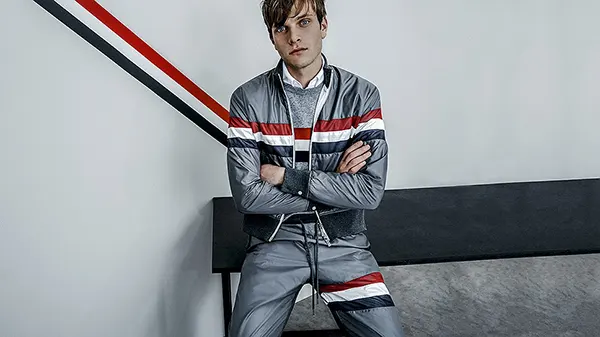
Thom Browne’s impact on businesswear extends well beyond the boundaries of luxury fashion. His innovations have encouraged a shift towards sharper silhouettes, refined proportions, and thoughtfully structured wardrobe essentials across global markets. Companies that previously adhered to strictly conventional dress codes now recognise the value of modern tailoring that balances professionalism with design awareness.
The use of cropped lengths, tonal palettes, and sculptural lines has become increasingly visible in business capitals such as New York, London, Seoul, and Tokyo. These interpretations of Browne’s visual language demonstrate how a once-radical aesthetic has become a respected standard within contemporary office dressing. His influence also appears in the expanding menswear segment of major fashion brands, reflecting the long-term significance of his innovations.
By 2025, Browne’s contribution to business style reflects a broader cultural shift: the desire for clothing that communicates confidence, clarity, and authenticity. His tailored creations demonstrate that formality can evolve without losing its foundation, offering a new chapter in the development of modern professional attire.
Browne’s Legacy and Continuing Role in Contemporary Fashion
Thom Browne’s legacy is defined by his ability to merge heritage with innovation. As his brand continues to evolve under his direction, the core principles of proportion, rigour, and narrative expression remain consistent. This continuity ensures that his work retains its relevance, even as global fashion undergoes rapid transformation.
His approach serves as a model for the next generation of designers, many of whom study Browne’s collections for their structural intelligence and conceptual clarity. Educational institutions frequently reference his work when teaching the relationship between design, storytelling, and cultural context, acknowledging its importance within contemporary fashion theory.
Looking ahead, Browne’s influence shows no sign of diminishing. His commitment to precision, craftsmanship, and artistic integrity provides a solid foundation for long-term relevance. The cropped suit, the structured uniform, and the theatrical presentation remain key components of his artistic identity, ensuring his continued presence as a leading figure in global fashion.